Hungarian painter, graphic artist, college professor
Budapest, February 27, 1926 – Zsennye, May 6, 1995
Erik Scholz’s artistic career spans five decades. He is characterized by his tireless pursuit of his own painterly language. His struggle to develop his own independent and authentic painterly language is reflected in the repeated transformation of his artistic microcosm. His art has always followed his own inner visual language. For this reason, Erik Scholz cannot be classified within any particular artistic or painterly movement.
Erik Scholz's body of work can be divided into three main periods:
1950–1963: The Era of Realism
This period was characterized by a search for his own artistic path and a deepening of his commitment to the style of realism. The depiction of reality was central to his works, while his individual artistic voice gradually took shape.
1964–1988: The Era of “Associative Naturalism”
During this period, Scholz developed his distinctive style, which he called “Associative Naturalism.” In his works, he drew on reality as a starting point and created through free association, combining naturalistic representation with exciting, symbolic elements.
1988–1995: The Period of Late Works
In the final phase of his life, Scholz’s spirit of experimentation found its fullest expression in the use of new techniques, such as Rhizoma and Plexol mixed with wood ash. Through these innovative methods, he aligned his art with contemporary trends while preserving his distinctive style of expression.
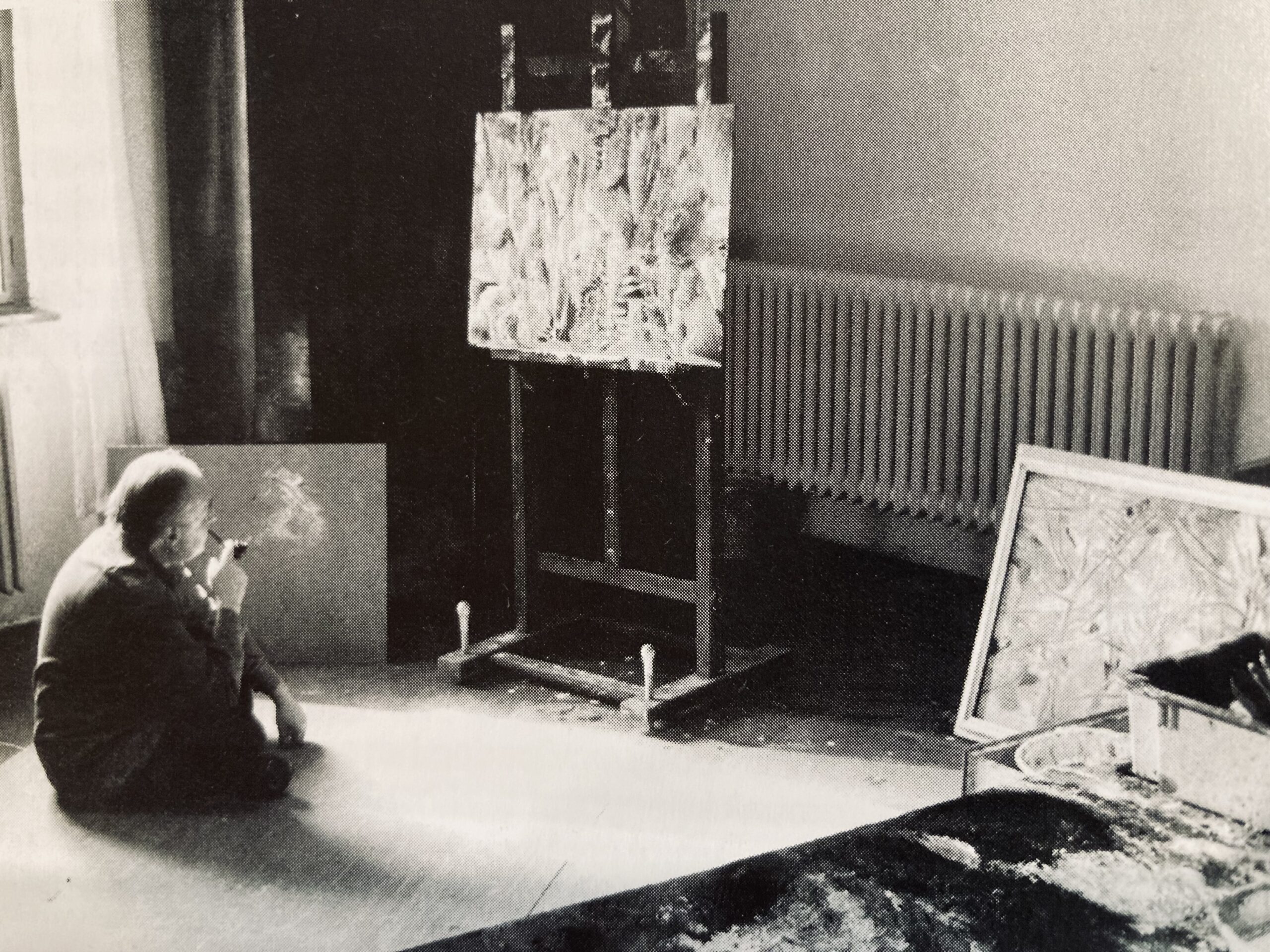
Erik Scholz had been studying at the Academy of Fine Arts in Budapest since 1944, in the studio of Professor István Szőnyi. However, the communist takeover of 1948 put an end to free expression in all areas. In the arts as well, only so-called socialist realism was permitted, and the visual arts were subordinated to politics. To avoid the prescribed style—the glorification of the working and peasant classes—Scholz transferred to Professor Géza Fónyi’s mosaic department.
We discovered that socialist naturalism could not be realized in the mosaic department. The material resisted! I began to understand how to translate visual concepts into the material. It was here that I developed a sense of the nature of the material—its ability to carry and convey spiritual content.
In 1949, Scholz graduated, but remained at the university for another year as a teaching assistant. It was during this period that he created his first oil paintings. In 1950, he received the state art award, the “Munkácsy Prize.” For the young Scholz, this early recognition sparked a multi-year ambivalence—typical of the era—between the “true” artist and the “compromising” artist. To make a living, he had to deliver one painting a week for state art commissions. He also produced portraits and landscapes. In 1955, his first solo exhibition was held in Szombathely, in western Hungary.
In 1957, the change in leadership from Stalin to Khrushchev marked a personal breakthrough for Erik Scholz: at the invitation of the “Salon Populiste,” he traveled to Paris in 1957. He stayed there for six months, supported at times by émigrés.
When I arrived in Paris, I was in shock! I had the feeling that everything I’d wanted to paint—now that I was finally free to paint whatever I wanted again—I’d already painted here. That’s why, at first, these impressions of Paris filled me with fear. At the same time, I also felt liberated, because it became clear to me that here, everything is allowed and everything is possible. There are no limits; everyone has a chance.
These experiences had a decisive influence on his artistic development. Above all, they enhanced the lightness of his compositions, his associative approach, and his use of various techniques.
His second creative period (1964–1988) can be divided into two main thematic areas, aside from a few minor stylistic changes and experiments with painting techniques: The group of figurative works includes imaginary portraits, the recurring theme of group portraits, and mythological and sacred works, all of which radiate a unique atmosphere. The second group consists of depictions of nature and its metamorphoses. Scholz himself refers to this period as “associative naturalism”:
I based my interpretation on the laws of nature.
In 1988, Scholz—by then an established artist—became financially independent and settled in Zsennye, a village in western Hungary, where he set up his studio in the former cowshed of a farmhouse. He broke with his previous artistic career and made a completely fresh start. His way of thinking had now become abstract and universal. His paintings had risen to a new spiritual level.
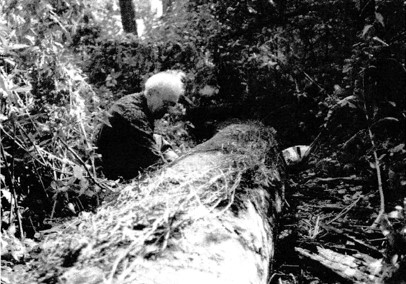
He found the rhizomorphs of the ringed stump fungus (Halimasch) in the floodplain forests along the Rába River. He removed these fungal strands after stripping away the bark of dead trees and used them as biological applications. The fungal filaments protruding from the picture’s plane make the surface of the painting exciting and spectacular, offering many opportunities for associations to unfold freely. The painter further develops the natural structures of the filament network within the painting. Monumental compositions emerge against a white background. The threads form human figures and emblem-like figures. In later paintings, the backgrounds become colorful. The rhizome strands undergo a transformation: their linear tangles take on a three-dimensional quality, defining space, and emerge plastically from the picture plane, becoming delicate, mysterious patterns.
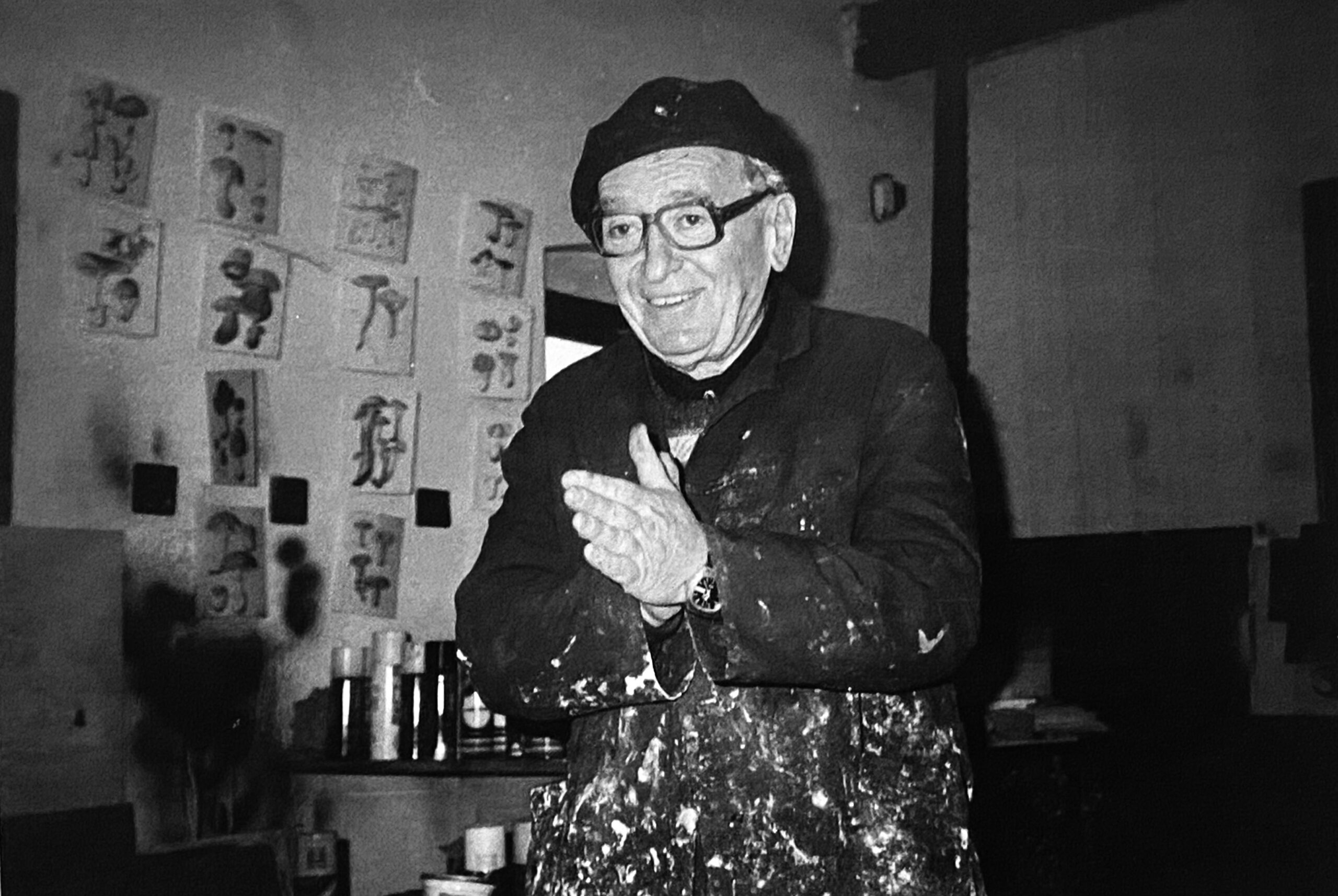
Lately, I’ve been experiencing some quite unusual things in my studio in Zsennye: When visitors arrive, I see a mixture of joy and wonder—no confusion at all. Usually, a visitor stepping into a modern artist’s studio lowers their head because they don’t understand right away and are waiting for an explanation. In my studio, people act just like children in a toy store: they completely let their guard down.
A few years before his death, Scholz underwent yet another shift in style and form, and began using new materials and techniques: he mixed wood ash collected from his own garden with other ash, and incorporated plexiglass into his work. These sculptural possibilities, interwoven with ascetic subtleties, gave his works a final pulse, with a particular emphasis on the depiction of movement.
The figures, depicted in dynamic motion, derive their three-dimensionality from the thickly applied, rough-textured wood ash and its coloring.
Scholz titled one of his most recent exhibitions “Atavisms.”
I summon the fragments of life from the past and the spirits of my ancestors, and I make their fates visible with the help of wood ash and rhizomorphs
References:
Erik Scholz Foundation, Budapest, 1996